AI-Assisted Search System for Laboratory SOPs
A proposal for a small AI-assisted search system that lets researchers find the right Standard Operating Procedure using natural language questions or keywords, without replacing existing SOP documents.
Role
Developer
Year
2025
Technologies
Semantic search, Document indexing, PDF/Word processing, AI retrieval
Overview
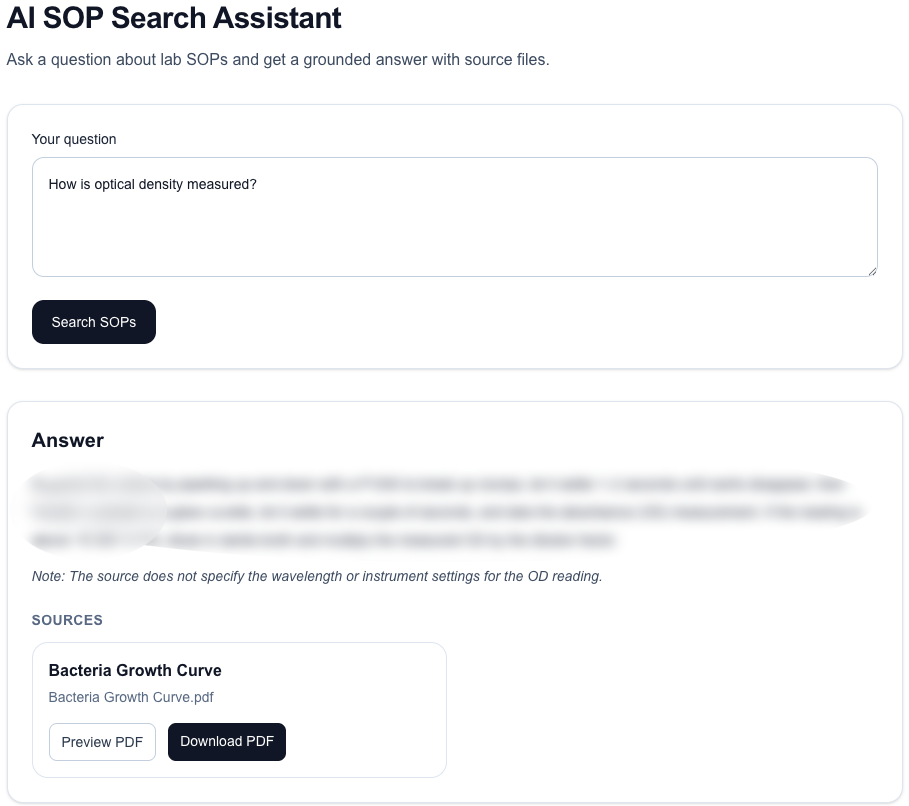
The laboratory maintains multiple SOPs covering experimental protocols, instrument operation, and safety procedures. As the number of SOPs grows, locating the correct document or section can become time-consuming. This proposal suggests developing a small AI-assisted SOP search system that allows researchers to quickly find the relevant procedure using natural language questions or keywords. The goal is not to replace existing SOP documents, but to create a search layer that helps researchers locate the correct SOP and section efficiently while ensuring that the most current approved version is used. The system would return the most relevant SOP document, the specific section containing the answer, a brief summary of the procedure, and a direct link to the full SOP. It does not generate new procedures; it only retrieves and summarizes information that already exists in approved SOPs.
Challenge
As the number of laboratory SOPs grows, finding the correct document or section is time-consuming. Researchers need to locate the right procedure quickly and ensure they use the most current approved version, without manually browsing folders or scanning long documents.
Solution
Proposed system: (1) SOP documents are collected in a central folder (PDF or Word). (2) The text of each SOP is processed and indexed. (3) An AI search tool analyzes the content and builds a semantic search index. (4) When a user asks a question (e.g. "How do I prepare samples for LC-MS?", "What is the protocol for centrifuge calibration?"), the system identifies the most relevant sections and returns them with links to the original documents. The system only retrieves and summarizes existing approved SOPs; it does not generate new procedures.
Results
- •Faster discovery of relevant SOPs
- •Reduced use of outdated or incorrect procedures
- •Easier onboarding of new lab members and trainees
- •Improved accessibility of lab knowledge and protocols
- •Demonstration of modern data-management tools within the lab